Muscular dystrophy is a group of more than 30 genetic (inherited) diseases that cause your muscles to become weak over time. These diseases affect the skeletal muscles — the muscles you use to move your body.
As time passes, the muscles get weaker and you may find it harder to walk, lift things, breathe, or do daily activities. In some types, the heart and lungs can also be affected.
Some forms start in childhood, while others appear in adulthood.
Common Types of Muscular Dystrophy
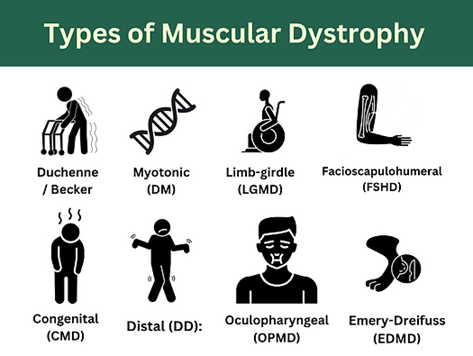
1. Duchenne Muscular Dystrophy (DMD)
- Most common in children.
- Mostly affects boys.
- Causes fast muscle weakness.
- Later affects the heart and lungs.
2. Becker Muscular Dystrophy (BMD)
- Similar to Duchenne but milder.
- Symptoms can appear anytime from age 5 to 60.
3. Myotonic Dystrophy
- Most common type in adults.
- Affects both men and women.
- Muscles have trouble relaxing.
- Can affect heart, lungs, thyroid and cause diabetes.
4. Congenital Muscular Dystrophy (CMD)
- Present at birth.
- Causes muscle weakness, joint stiffness or looseness.
- May also affect brain, eyes, and breathing.
5. Distal Muscular Dystrophy
- Affects hands, feet, lower arms, and legs.
- Starts usually between ages 40–60.
6. Emery-Dreifuss Muscular Dystrophy
- Usually affects boys and young men.
- Weakens shoulder, upper arm and leg muscles.
- Can cause serious heart problems.
7. Facioscapulohumeral Dystrophy (FSHD)
- Affects face, shoulder, and upper arm muscles.
- Symptoms usually start before age 20.
8. Limb-Girdle Muscular Dystrophy (LGMD)
- Affects shoulder and hip muscles.
- Happens in both children and adults.
9. Oculopharyngeal Muscular Dystrophy (OPMD)
- Weakens eyelids and throat muscles.
- Causes droopy eyelids and trouble swallowing.
- Usually starts around age 40–50.
How Common Is It?
Muscular dystrophy is rare.
- Overall: affects 16–25 people out of every 100,000.
- Most common in children: Duchenne.
- Most common in adults: Myotonic dystrophy.
Symptoms
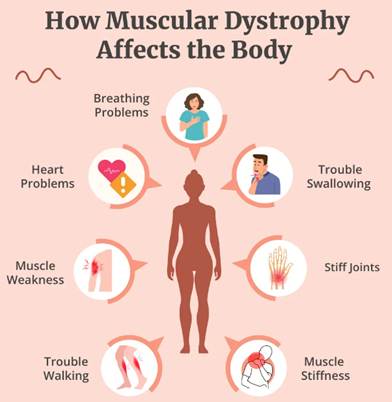
Main problem: muscle weakness that gets worse over time.
Muscle-related symptoms
- Muscles become smaller (atrophy).
- Difficulty walking, running, or climbing stairs.
- Waddling or unusual walking style.
- Joint stiffness or looseness.
- Muscle tightness (contractures).
- Muscle pain.
- Spasms or spasticity.
Other symptoms
- Tiredness.
- Trouble swallowing.
- Heart problems (like arrhythmia or heart failure).
- Breathing difficulties.
- Curved spine (scoliosis).
- Learning or intellectual difficulties (in some types).
What Causes Muscular Dystrophy?
Muscular dystrophy happens because of a problem in the genes that are supposed to keep muscles healthy. When these genes are changed (mutated), the muscles cannot repair themselves properly — so they slowly get weaker.
Most people inherit these gene changes from their parents.
Ways it can be inherited
- Recessive inheritance
- You get the faulty gene from both parents.
- Dominant inheritance
- You get one faulty gene from just one parent.
- X-linked inheritance
- The faulty gene is on the X chromosome.
- Mostly affects boys more severely (like Duchenne and Becker).
Rare case
- Sometimes the mutation happens randomly — not inherited.
This is called a de novo mutation.
 Sneh Lifescience
Leave a comment